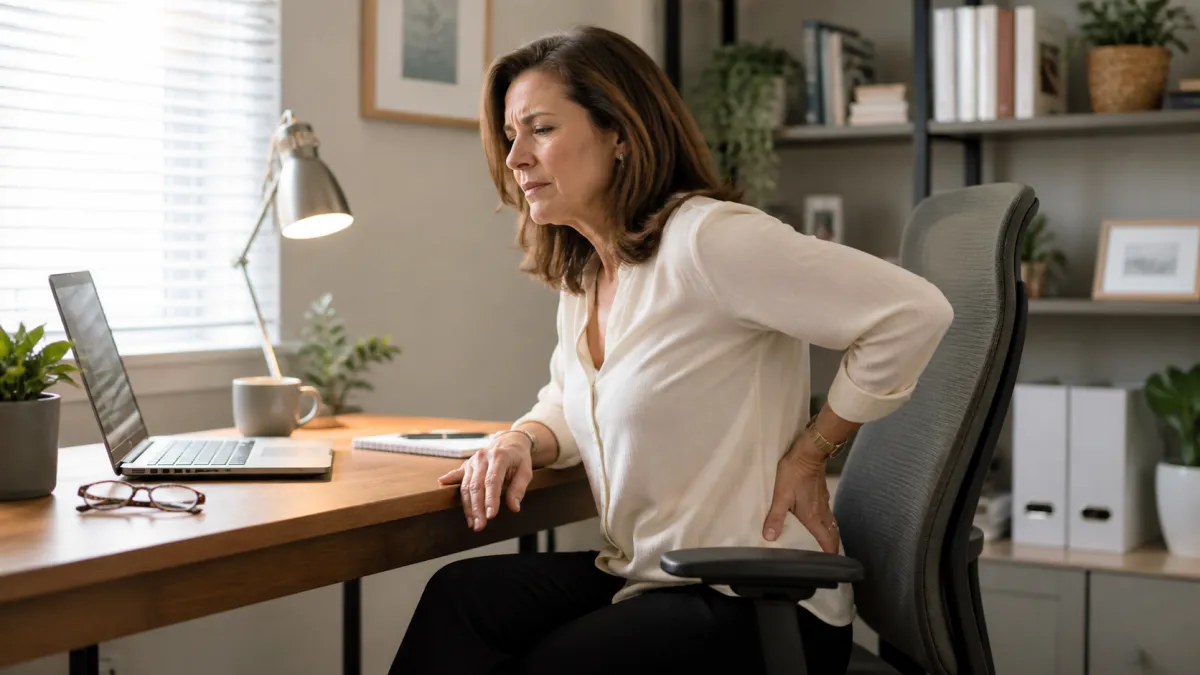
Why Does My Back Hurt When I Sit Down? | Health in Motion Osteopaths
Why Does My Back Hurt When I Sit Down, Even Though I’m Fine When Active?
You can be active all day.
You can walk, cycle, ski, keep moving, and feel as though your back is coping fine.
Then you sit down.
You sit for work, or you try to relax on the sofa, enjoy a meal out, read a book, watch TV, or simply have a quiet evening. And suddenly your back starts to complain.
That can feel confusing.
It can also feel deeply frustrating, because the problem is not only the pain. The fact is, rest does not feel restful. Sitting with friends, enjoying dinner, or settling at the end of the day can start to feel like something you have to manage.
If your back feels better when you move, but worse when you sit, it will help to break down the "sitting activity" to identify which part you are struggling with.
Claire’s story: active, capable, but unable to settle when sitting
A patient I’ll call Claire described her experience as follows.
She is very active, but complained of severe back pain when sitting. While walking, cycling and even on a recent ski holiday, her back felt fine. But sitting was different. She found it difficult to sit on the sofa and watch TV. When she went out for dinner, she found herself needing to get up, stretch and walk around the restaurant. At work, she would stand in a meeting while everyone else was seated. The most difficult pattern was around sitting itself, with some discomfort also showing when she moved from sitting to standing. She mentioned feeling embarrassed, winced, and hobbled away after sitting for short periods.
When patients tell me they have back pain related to sitting, I listen for which of these four different patterns occurs.
Does your back hurt when you move from sitting to standing?
This is the pattern where sitting may be manageable for a while, but getting up from the chair is the difficult part.
You may feel stiff, guarded, slow, or caught as you move from sitting to standing. In Claire’s case, this was part of her presentation. She described the pain as being particularly noticeable “from sitting to standing.”
Here, the length of time sitting is relevant. Joints and muscles can stiffen up if inactive for a few hours. Are muscles performing properly? Are they kicking into action to lift the body from sitting to standing. If not this can feel like painful awkward and difficult movement. The surface is also important. If sat on a soft surface (like sofa) this will overstretch structures in the body, so when you come to move, they are not ready and trigger pain
Does your back hurt when you move from standing to sitting?
This is a different pattern.
Here, the pain comes as you lower yourself into the chair. You may feel uncomfortable before you are fully seated, or you may brace as you move into a seated position.
This may be a sign that muscles are stiff and guarded. There may be a muscle spasm in the muscles, so they don't feel free to stretch as you change body position. You may have been struggling with back pain for a while and are bracing when you sit.
Does your back stiffen after sitting for a long time?
Some people are comfortable at first, but after a longer period of sitting, the back stiffens. The first few steps afterwards may feel awkward, heavy or restricted.
This happens mostly to people who have to sit for a living. While sitting, the muscles are not active, so joints in the spine pelvis and hips are holding your whole upper body weight. Depending on body position and surfact, Musles and ligaments are also getting over stretched and accumulating micro injury. The body process of healing this micro injury can generate inflammation, which can act after a painful irritant if there is not adequate movement and hydration to circulate the irritant away.
In this modern age of hybrid working, there is less movement as people work from home, often on surfaces not fit for long hours of work (sofa and beds in some cases). Longer hours worked as people are not having to spend time commuting
Is your back uncomfortable while you are sitting?
This was the main part of Claire’s pattern.
She struggled to sit comfortably for any period of time. She could read or watch TV lying down, but sitting on the sofa was difficult. Sitting in a restaurant became something she had to manage by getting up, stretching and walking around.
This can be one of the most exhausting patterns because sitting is supposed to be the easy thing.
It is supposed to be rest.
But if your back feels worse when you sit, you may start to feel as though you cannot properly switch off. You may dread the sofa. You may avoid longer meals. You may feel restless in your own body.
As a practitioner, the most imprtant thing to look for is structures being painfully compressed as you sit, such as the sciatic nerve, the coccyx, discs. But in the absence of physical compression. There is another, less obvious cause.
One of the important themes in Claire’s consultation was that her back pain was happening alongside a significant emotional load. She was carrying worry and sadness about someone she loved, while also trying to keep going and hold things together. We talked about how suppressing grief or stress can sometimes keep the body in a more guarded state.
This does not mean the pain is imaginary.
It means the body is not separate from the life you are living.
Sometimes the body can feel comfortable when you are moving, doing and keeping busy - because it is distracted. Then, when you sit down and everything becomes quieter, the emotional pain can become physical pain. This is an area I have been doing more work in in recent years.
What can you do in each case?
The best starting point is to match the strategy to the pattern.
If your back hurts when moving from sitting to standing
Before you stand, mobilise your body. Activate your posture so you feel ready stand and rock from bum check to the other. Once standing, shift wieght from one foot to the other before walking away from the desk. This will wake up your body. Get it ready to motor your body weight before moving.
[video link]
If your back hurts when moving from standing to sitting
Slow the movement down.
Repeat the movements in the above videos, in reverse order. If you are not doing reg exercise and may be losing muscle mass, I would consider taking up a gentle activitiy to build or at least maintain strength. Practice this chair squat exxercise at work, or before sitting dowm.
[video link]
If your back stiffens after sitting for a long time
Do not wait until your back is already shouting.
Set alarm to stand and move for a few seconds every 45 mins. See the first 2 videos above for movement. in this section is a video to pump the joints of the spine to decompress them from long periods sitting. Do these a few times per day. You don't need to bend forward very far to achieve the pumping action.
If your back is uncomfortable while you are sitting
This one needs to be checked out by a appropriate qualified professional, especially if getting worse or casing pain to radiate into the legs. In the absence of structures being compressed, it may be determined that your nervous system is "restless" due to hidden or obvious nervous system overload - ususally caused by prolonged stress. This was the case for claire.
What I suggested Claire do
Because her pattern involved discomfort while sitting, difficulty relaxing, and a lot of emotional strain, I suggested a calming reset for her body.
The reset was simple:
Lie on your back on the floor with your legs supported over a chair. Place your hands on your tummy. Breathe gently and feel the abdomen rise and fall. I also mentioned gentle rocking movements, describing it like rocking a baby, as a way of soothing the nervous system.
I suggested she try this before the time of day when sitting and relaxing became difficult, such as before settling down in the evening.
We also talked about the emotional load she was carrying. I suggested she spend a few minutes each day imagining a more hopeful future around the situation that was weighing heavily on her. Not as a way to deny what was hard, but as a way to help her body spend a little time in possibility rather than fear.
That matters because, for some people, pain is not only about the position of the spine.
It is also about whether the whole person feels safe enough to rest.
When should you get help?
It may be time to seek help if back pain linked to sitting keeps returning, is getting worse, stops you relaxing or socialising, affects your confidence, or makes everyday activities feel difficult to trust.
You should also seek advice if your symptoms are severe, changing, unusual or worrying.
You do not have to wait until you can barely move.
Sometimes the most helpful time to get support is when you are still active, but you know something about your pain pattern is stopping you from living comfortably.
If sitting has become the thing your body struggles with most, it does not mean your back is broken.
It may mean your body needs a clearer assessment, a calmer strategy, and a more personalised way back to comfortable rest.
Friendly disclaimer: This blog is for general education and support. It is not personal medical advice and may not replace individual assessment or treatment. If your symptoms are severe, changing, or worrying, please seek advice from an appropriate qualified health professional.
Content check
What came directly from your content:
Claire’s story, the active-but-uncomfortable-sitting pattern, difficulty sitting on the sofa, difficulty sitting in restaurants, needing to get up and stretch or walk around, pain moving from sitting to standing, the emotional stress link, the legs-over-chair reset, hands on tummy, breathing, gentle rocking, trying different resting positions, and the visualisation practice.
Placeholders added:
Placeholders were added where the transcript did not provide enough detail on standing-to-sitting pain, long-sitting stiffness, and specific movement cues for each pattern.
Areas where the source material was thin:
The transcript was strongest for discomfort while sitting and pain moving from sitting to standing. It was thinner for pain moving from standing to sitting, stiffness only after long periods of sitting, chair-related guidance, and detailed biomechanical explanations.
